
So your Bosch dishwasher finished its cycle and left you with a murky puddle instead of clean dishes. Classic. Before you panic or start Googling repair prices in the Bay Area (trust me, I’ve been there), here’s the good news: nine times out of ten, it’s just gunk in the filter or something jamming the impeller. And you can fix it yourself with stuff you already have in your kitchen.
There are only five places a blockage can hide, and they sit in a line running from the tub outward. So we follow the water. Stage one is inside the machine. Stage two is the plumbing under the sink. Most people never get to stage two.
Seeing E24 or E25 on the display? You are in exactly the right place.
Grab This Stuff First
- Sponge and a bucket
- Turkey baster
- Old toothbrush
- Teaspoon (yes, really)
- Tweezers
- Rubber gloves
- Wet/dry vac if you have one
- Dishwasher cleaner, or plain white vinegar
- Tray and an old towel
- Your phone, for the flashlight
Nothing here costs you a dime you have not already spent. The teaspoon and the baster are the two that actually matter, and I will explain why when we get to them.
Video Guide: Clearing a Blocked Bosch Drain Pump
Before Anything, Make It Safe
Switch the machine off and unplug it at the wall, not just at the control panel. A Bosch that is only “off” at the panel is still live, and you are about to put your hands inside the sump.
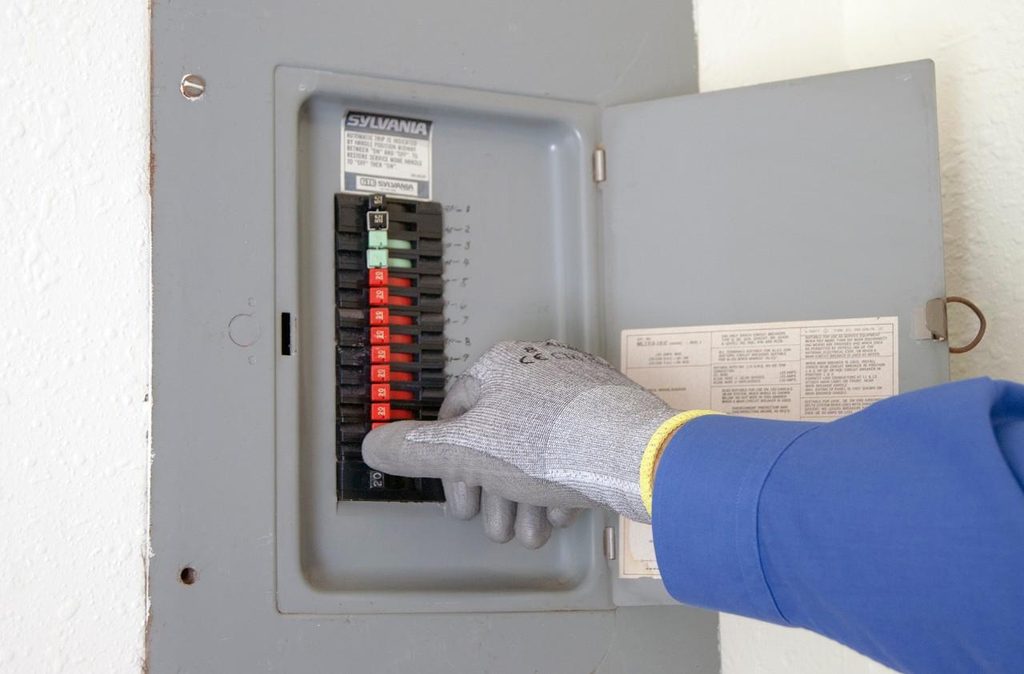
If the outlet is behind the cabinet and you cannot reach it, trip the breaker instead.
Gloves on. And give it time. Straight after a Normal or Auto cycle the water in that tub has been sitting near 150 degrees, and it stays hot longer than you expect.
Step 1. Remove the Filter and the Bottom Rotor
Take the lower spray arm off next. Grip the center hub and pull straight up. It should come off easily. If it resists, twist it slightly and pull again. Do not lever it.
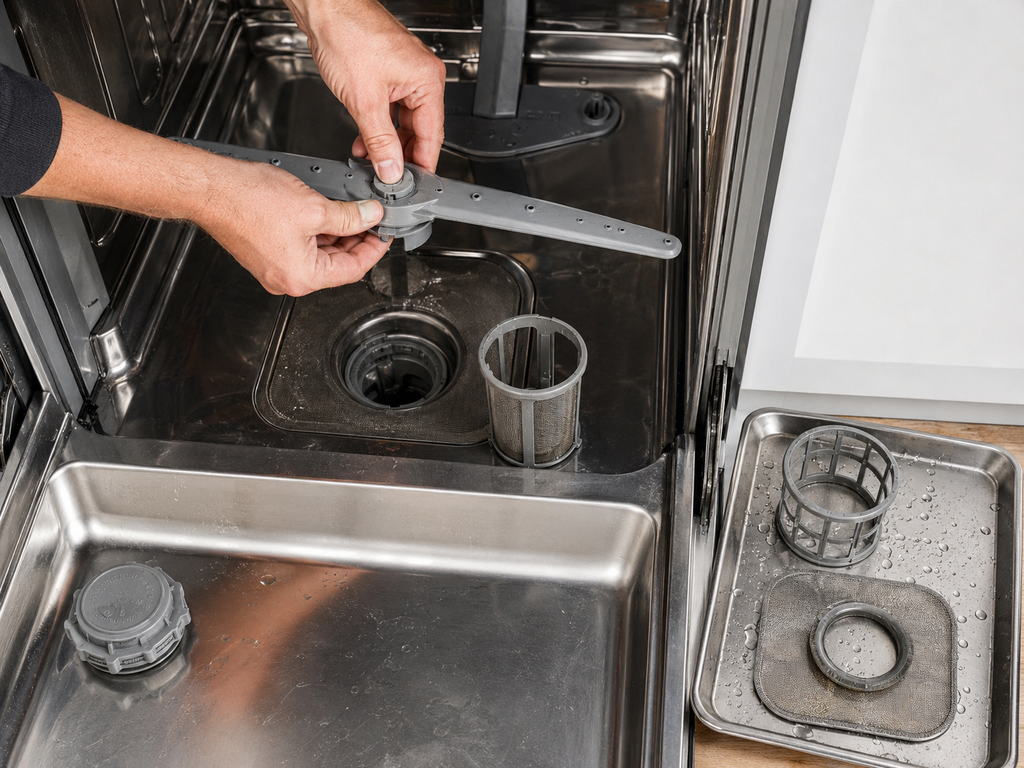
The filter sits dead center in the tub floor. It comes apart in three pieces.
- The tall mesh cylinder. Turn counterclockwise a quarter turn, lift out.
- The flat filter around it. Lifts out once the cylinder is gone.
- The micro filter underneath. Pinch the catches to release.
Rinse all three under the hot tap. Use the toothbrush on the rim between the coarse and fine filter. Grease collects there as a grey film that looks like nothing and blocks like concrete.
Set the clean parts on the tray. Do not reinstall them yet.
Step 2. Clear the Standing Water Out First
You cannot see a jammed impeller through four inches of grey water, and you cannot work in it either. Get the water out before you touch anything else.
You cannot see a jammed impeller through four inches of grey water, and you cannot work in it either. Get the water out before you touch anything else.
Squeeze the water into the bucket. When you cannot reach any further down, use the spoon to get the rest of the water out.
How dry is dry enough
Dry enough means you can see the bottom of the sump clearly and the pump cover is not sitting under water. You do not need it bone dry. Bosch deliberately leaves a shallow film of water in the sump at the end of every normal cycle to keep the drain seal from drying out, so a thin puddle below the filter line is not a fault and never was. What you are clearing is the inch or more of standing water that covers the tub floor and stays there after the cycle ends.
One more thing about hot water
If the cycle just ended, either wait fifteen minutes or wear the gloves and get on with it. Do not skip the gloves because you are impatient. Broken glass in that water is common enough that it is the entire reason step 4 exists.
Step 3. Remove the Impeller Cover
Look into the sump for a white plastic cover sitting flush in the floor, off to one side. That is the drain pump cover, with the impeller under it. Check the edge for a small notch. That is the pry point. Older models use a single Torx T15 or T20 screw instead. Back it out and keep it clear of the sump.
Use a blunt tool only
Teaspoon handle in the notch. A butter knife works. Nothing pointed, no screwdriver, no chisel, and never a power tool. The sump is thin plastic and the cover seals against it. Gouge that face and a clog becomes a leak.
Lever gently and let the cover lift on its own. It should click, not crack.
Step 4. Remove Any Debris
The cover is off and you are looking at the drain pump impeller.
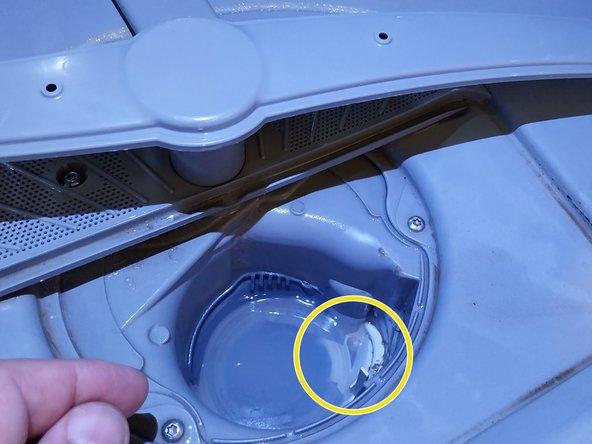
What jams an impeller
Broken china. Slivers of glass from a wine stem that shattered three cycles ago. Sweetcorn kernels, which are almost purpose built to wedge in an impeller vane. Olive pits, fruit stickers, twist ties, a plastic cap off a bottle, and hair.
That list is worth reading twice, because most people recognize their own kitchen somewhere in it. If a glass broke in that dishwasher within the last month, you have very likely just found your answer.
Getting debris out safely
Tweezers for anything you can see and identify. Wet/dry vac nozzle or the turkey baster for anything you cannot reach or cannot make out.
The hard rule, and there is only one hard rule in this entire job, is that you do not feel around blind with bare fingers. Glass and china are the usual culprits down there, and the edges are fresh. Light first, tweezers second, fingers never.
Shine the flashlight in from a low angle rather than straight down. Glass is transparent and it hides beautifully under direct light.
Step 5. Rotate the Impeller by Hand
Gloves still on. Put a fingertip on one blade and turn the impeller.
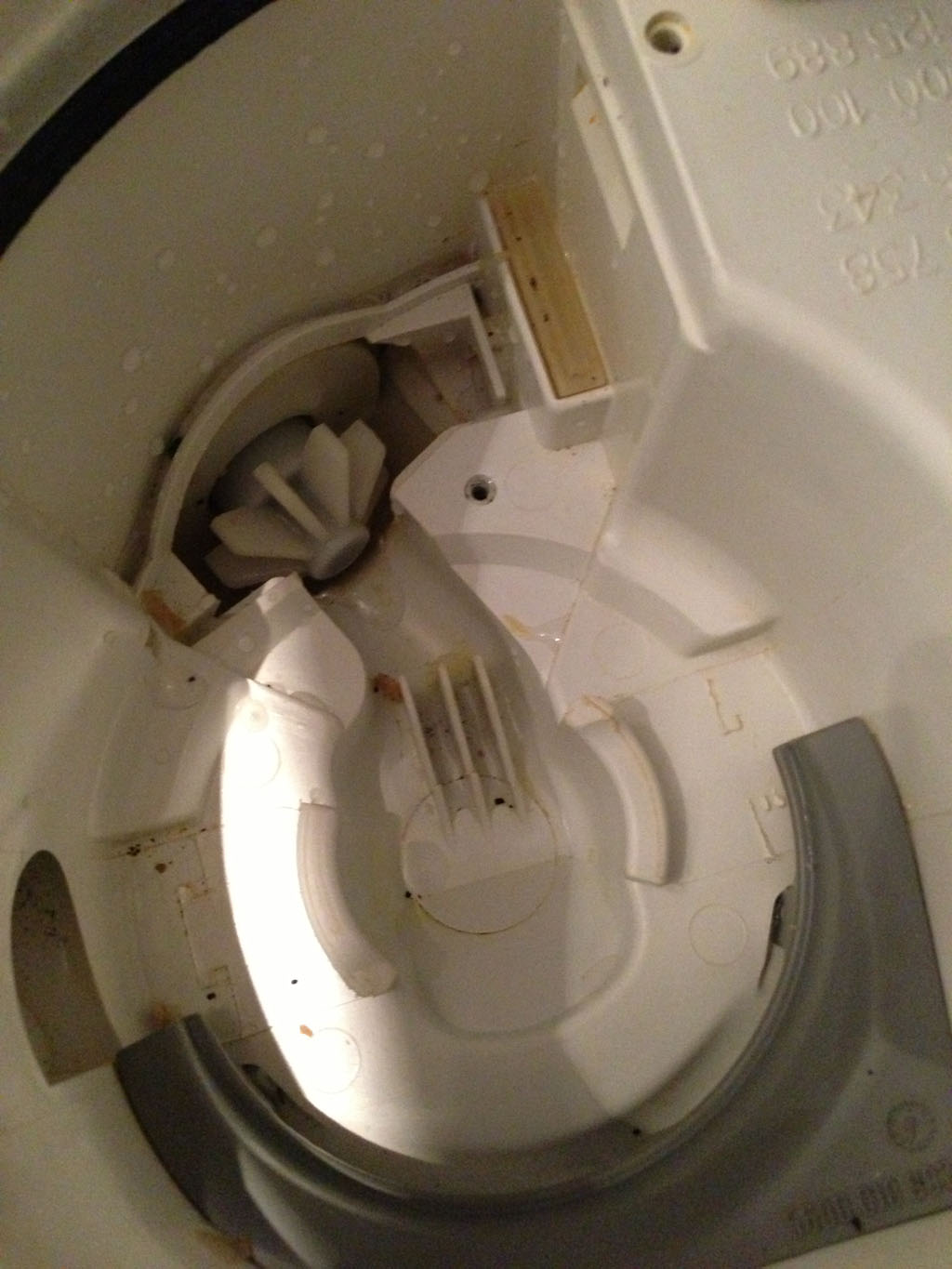
What free rotation feels like
It should turn with light, even resistance. Smooth the whole way around, both directions, no catch and no grinding. You may feel faint clicks as it goes. That is the magnet in the motor and it is normal.
Step 6. Reassemble the cover
Everything goes back the way it came out.
The pump cover slides down and pops in under its clip. You will hear it click, and you should. A cover that is merely resting in place will throw E25 the moment the pump runs.
The filter body drops in without force. If you are pushing, it is not seated. Turn it clockwise about 90 degrees until the arrows line up, because aligned arrows mean locked.
Step 7. Run the Test Cycle
Plug the machine back in or flip the breaker on.
Before you start a full cycle, run a drain on its own. On nearly every Bosch made since about 2008, across the 100, 300, 500, 800, and Benchmark lines, holding the Start button for three to five seconds cancels the current program and runs the drain pump. Close the door and listen. You want a low, steady hum for a minute or so and then silence.
Then run a short hot cycle empty with a dose of dishwasher cleaner in the tub. This flushes whatever you loosened but did not remove, and it tells you whether the fix holds through a full drain and refill rather than just one pump run.
Stay in the kitchen for that cycle. If you knocked the check valve or unseated something, you want to be standing there.
Still Not Draining?
It may be time to call a professional. The issue could be a failed drain pump, blocked hose, air gap, check valve, wiring, or another hidden problem.
Get a professional diagnosis with free diagnosis and upfront pricing before any repair.
When to Call a Professional
Stop and call someone if any of the following is true.
- The impeller is clear and free, stage two checked out, and the machine still holds water.
- You hear a hum from the pump area during the drain phase but nothing moves.
- The machine shows E15, which means water has collected in the base pan and the AquaStop float has tripped. There is a leak somewhere, and clearing the drain will not fix it.
- Water is standing in the tub and also backing up into the sink, which points at the branch drain rather than the appliance.
- The drain pump needs replacing. It is not a repairable part, and it is not a first repair.
SF repairs Bosch dishwashers across the San Francisco Bay Area, and we offer same day service in most of the Peninsula. Before you call, grab the model number from the sticker on the door frame edge, listed as the E-Nr, and note any error code on the display. It cuts diagnosis time considerably.
FAQs
Is it normal to have a little water in the bottom of a Bosch dishwasher?
Yes. A thin film of water below the filter line is normal on every Bosch and keeps the drain seal from drying out. A failure looks different. It covers the whole tub floor, usually an inch or more deep, and it is still there hours after the cycle ended.
What does E24 mean on a Bosch dishwasher?
E24 is a drain fault. The control board ran the drain pump and never got confirmation that the water left, so it stopped the cycle. It is broad by design and covers a clogged filter, a jammed impeller, a loose pump cover, a kinked or blocked drain hose, and downstream blockages like a plugged air gap. It does not by itself mean the pump has failed.
What is the difference between E24 and E25?
E24 points at the drain path generally. E25 points specifically at the drain pump being blocked, or at the pump cover being loose or missing. In practice you clean the same components for both, but E25 makes you check that the pump cover clicked back into place.
How do I force my Bosch dishwasher to drain?
Press and hold Start for three to five seconds, then close the door. The pump runs for about a minute. Some older models use a two button Cancel Drain combination on the panel instead. Note that a reset drains the tub and clears the code, but it does not clear whatever caused the code.
Can I use Drano or a chemical drain cleaner in my dishwasher?
No. Chemical drain cleaners damage the seals, hoses, and stainless components inside the machine, and they will sit in the tub rather than draining out, which is the whole problem you are trying to fix.
Why did my dishwasher stop draining right after I got a new garbage disposal?
The knockout plug in the disposal inlet was almost certainly left in place. It seals the dishwasher port so the disposal does not leak when it is sold without one, and the installer has to punch it out. This is one of the most common causes of a dishwasher that has never drained since installation day.
Does this guide work for Siemens and Neff dishwashers too?
Largely yes. Siemens and Neff dishwashers are built on the same platform and use the same E24 and E25 codes, the same filter and pump cover layout, and the same teaspoon trick on the cover clip.
How much does a Bosch drain pump replacement cost?
Parts run roughly 90 to 150 dollars, and installed cost typically lands somewhere between 250 and 400 dollars depending on the model and access. It is worth confirming the pump is genuinely dead before authorizing it, because a blocked impeller presents identically and costs nothing to clear.